

One of the frustrations I sometimes observe when people begin an exercise programme is the expectation that progress should happen in a straight line.
They expect to feel a little stronger every week.
They expect their balance, mobility, coordination and energy to keep improving without interruption.
They imagine that if the programme is working, each week should be better than the previous one.
That would be wonderful.
But it is rarely how the human body works.
Real progress is not usually a perfectly straight line moving continuously upwards.
It is more often a journey of improvement, adaptation, plateaus, temporary setbacks, recovery and further improvement.
Understanding this can completely change our relationship with exercise, ageing and our own body.
The Three Possible Lines
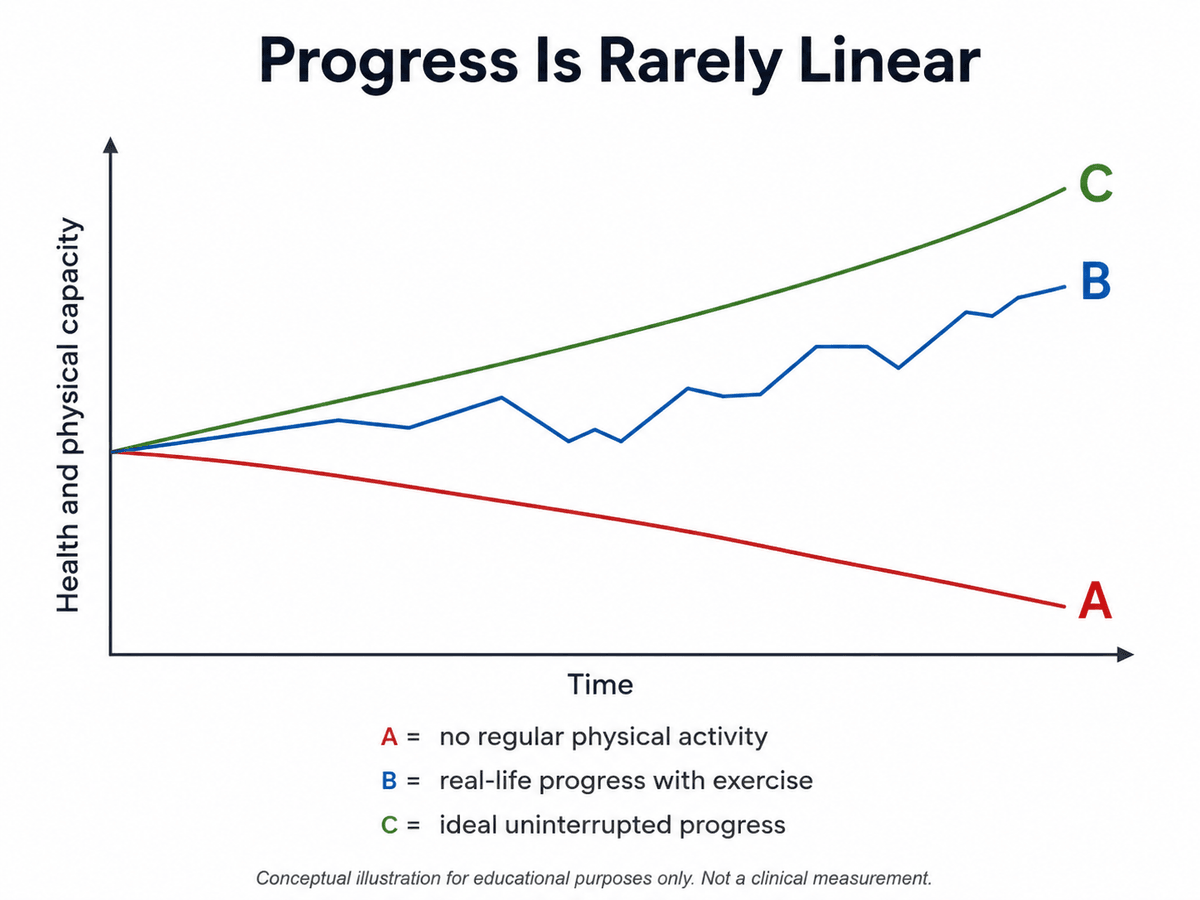
The graph accompanying this article represents three different possibilities.
The first line (A) represents someone who does not practise regular physical activity.
Over time, this person may gradually lose strength, mobility, balance, cardiovascular capacity, coordination and confidence.
This decline will not happen at exactly the same speed for everyone. Genetics, illness, nutrition, lifestyle, sleep, stress and many other factors influence the process.
However, without sufficient physical stimulation, the body generally has fewer reasons to preserve its capacity.
The second line (C) represents the ideal situation we would all like to experience.
The person begins exercising and progresses continuously.
Every month, they become stronger, fitter, more mobile and more capable.
There are no interruptions, no illnesses, no pain, no stress, no holidays, no family problems and no unexpected events.
This line is possible as an illustration.
But it does not represent real life for most people.
The third line (B) is usually the most realistic.
The overall direction is upwards, but the journey contains fluctuations.
There are periods of progress.
There are plateaus.
There are moments when the programme must be adjusted.
There may even be short periods of regression.
But over months and years, the person continues moving towards greater health, physical capacity and independence.
The Body Does Not Follow a Perfect Calendar
Let us imagine that someone over 60 or 70 begins an appropriate physical activity programme.
During the first weeks, the person begins to feel better.
They may notice more energy.
Getting out of a chair becomes easier.
Walking feels more comfortable.
Balance improves.
Movements that initially felt unfamiliar begin to feel more natural.
The person becomes motivated because the progress is visible.
Then something unexpected happens.
A shoulder becomes painful.
A knee becomes irritated.
The person experiences unusual fatigue.
The body may simply be asking for a temporary change.
The programme now needs to be adapted.
The person may need to reduce the load, avoid certain movements or practise simpler exercises for a few days or weeks.
Progress may temporarily slow down.
The curve may enter a plateau.
There may even be a small regression in some areas.
This does not necessarily mean the programme has failed.
It may mean that the programme is respecting the body.
Adapting the Programme Is Not Giving Up

Many people interpret a reduction in training as failure.
They think:
“I was progressing, but now I have gone backwards.”
“My body is letting me down.”
“I am too old for this.”
“The exercise must not be working.”
But reducing or adapting the programme can be an intelligent training decision.
There is a major difference between abandoning movement and temporarily changing the way we move.
If the shoulder is painful, we may still be able to train the legs, balance, walking, breathing or gentle mobility.
If the knee needs less load, we may still work on the upper body, coordination, floor movements or exercises in a supported position.
If the person feels exhausted, the session may become shorter and more restorative.
The objective is not always to do more.
Sometimes the objective is to preserve the habit, maintain what is possible and give the body the conditions it needs to recover.
Illness Can Temporarily Change the Curve
Later, another unexpected event may occur.
The person becomes ill and needs to stop exercising completely for one or two weeks.
During this period, physical capacity may decrease.
Strength may feel lower.
Energy may disappear.
Movements may feel more difficult.
Confidence may also be affected.
When the person returns, it may not be appropriate to restart at exactly the point where they stopped.
They may need to return to an earlier and simpler version of the programme.
This is not failure.
It is good coaching.
It is respect for biology.
It is common for some training adaptations to decrease during a period without exercise. Research with older adults has found that strength and functional improvements can be partially reduced during detraining. However, previous gains may also be partly preserved, and retraining can help people recover lost capacity.
We do not always return to zero.
The body has already experienced the training.
The nervous system has already learned movements.
The muscles have already received stimulation.
The person has already developed knowledge, confidence and experience.
The return may require patience, but it is not necessarily a complete restart.
Two Steps Forward and One Step Back
One of the main messages I want to share is very simple:
Two steps forward and one step back still leaves us one step ahead.
Two minus one equals one.
Imagine that during three months of training, you improve your strength, balance and mobility.
Then an illness, a painful joint or a stressful life event causes a temporary regression.
You may lose part of what you gained.
But you may still be in a better position than when you started.
You may then take another two steps forward.
Later, you may take one step back.
Then three steps forward.
Then another small step back.
This is how progress often happens.
The individual moments may look confusing, but the long-term direction can still be positive.
The important question is not:
“Did I improve every single week?”
A better question is:
“Where is my overall health and physical capacity moving over several months or years?”
What Happens When We Take No Steps Forward?
Now imagine a different situation.
The person does not practise physical activity.
They do not challenge their strength.
They do not train their balance.
They do not explore mobility.
They do not practise getting down to and up from the floor.
They do not stimulate their cardiovascular system.
Life will still bring illness, pain, stress, ageing, difficult periods and unexpected events.
But this person has not taken the previous steps forward.
When life creates a step backwards, there is no reserve of physical capacity to help compensate for it.
This is one of the reasons regular physical activity is so important.
Training does not make us immune to illness, injury or ageing.
It helps us build greater physical reserve and resilience before those challenges arrive.
Older adults, including people over 85, can still improve muscle strength, muscle size and physical performance through progressive resistance exercise. In one study, adults aged 65–75 and adults over 85 both made meaningful improvements after twelve weeks of training.
The purpose of training is not to create a body that never experiences difficulty.
The purpose is to create a body that is better prepared to respond to difficulty.
Plateaus Are Also Part of Progress
Not every period without visible improvement is a regression.
Sometimes the curve becomes flat.
We call this a plateau.
The person continues exercising, but the results are less obvious.
This can happen because the body is consolidating previous adaptations.
It may happen because the programme needs to change.
It may happen because the person is sleeping poorly, experiencing stress or not recovering sufficiently.
It may also happen because progress becomes less visible after the initial improvements.
When someone begins from a low level of fitness, the first changes may appear quickly.
Later, smaller improvements may require more time, greater consistency and more specific training.
A plateau does not automatically mean that nothing is happening.
Maintaining strength, mobility or balance during a difficult period may itself be a success.
Without exercise, the person might have declined.
The training may be preventing that decline even when the graph appears temporarily flat.
Do Not Judge a Long Journey by One Difficult Week

A common mistake is evaluating the entire programme based on a short period.
The person has one difficult week and concludes that the training is not working.
They compare today with their best day rather than comparing today with where they began.
This creates unnecessary frustration.
Progress should be evaluated across longer periods.
Instead of asking only:
“How do I feel today?”
We can also ask:
“What can I do now that I could not do six months ago?”
“Am I recovering more effectively?”
“Do I have more movement options?”
“Am I stronger, more confident or more independent than when I started?”
“Even after this setback, am I still ahead of my original starting point?”
These questions provide a more honest picture.
Returning at a Lower Level Is a Sign of Intelligence
After illness, pain or a long interruption, some people try to return immediately to their previous level.
They want to use the same weights.
They want to perform the same number of repetitions.
They want to move with the same speed and complexity.
They believe that reducing the programme means accepting defeat.
But the body may no longer be ready for the previous demand.
Returning temporarily to a simpler level can protect the body and create the conditions for future progress.
We can reduce the load.
We can reduce the volume.
We can reduce the speed.
We can simplify the movement.
We can increase the recovery time.
Then, as the body responds, we gradually rebuild.
Regression within the programme is not always regression in the person.
Sometimes it is the strategy that allows the person to continue moving forwards.
How to Respond to a Temporary Setback
When progress is interrupted, five principles can help:
- Adapt rather than abandon. Continue doing what the body can safely tolerate.
- Preserve the routine. A shorter or simpler session can help maintain the habit and the relationship with movement.
- Return gradually. Do not assume that the body is immediately ready for the previous level.
- Communicate honestly. Tell your coach about pain, illness, fatigue, medication changes and other relevant circumstances.
- Evaluate the long-term direction. Measure progress over months, not only from one session to the next.
These principles help transform a setback into part of the training process rather than the end of the process.
Unrealistic Expectations Create Unnecessary Suffering
When people expect uninterrupted progress, every plateau feels like a problem.
Every painful joint feels like failure.
Every illness feels like losing everything.
Every easier session feels like weakness.
But when people understand that fluctuations are normal, their interpretation changes.
They become more accepting.
They become more patient.
They become less critical of themselves.
They are more willing to adapt the programme instead of abandoning it.
They understand that respecting the body is not the opposite of progress.
Respecting the body is part of progress.
The Empowered Ageing Perspective
At Empowered Ageing, progress does not mean constantly forcing the body to do more.
It means helping the person move towards greater capacity, confidence, autonomy and health while responding intelligently to the reality of their life and body.
Some weeks will be focused on progression.
Other weeks may be focused on adaptation.
Sometimes the objective will be to become stronger.
Sometimes the objective will simply be to preserve movement during a difficult period.
Sometimes progress means doing more.
Sometimes progress means doing less, but doing it wisely.
The programme must serve the person.
The person should not be forced to serve an inflexible programme.
Final Reflection
Progress is rarely a perfectly straight line.
It is more often a series of advances, plateaus, adaptations, interruptions, recoveries and new advances.
There will be moments when we take two or three steps forward.
There may be moments when we take one step back.
But one step backwards does not erase the entire journey.
What matters is the long-term direction.
A temporary regression is not the same as giving up.
A plateau is not always failure.
Adapting the programme is not weakness.
Starting again at a simpler level is not returning to zero.
The real danger is not taking occasional steps backwards.
The greater danger is never taking any steps forward.
Keep moving.
Keep adapting.
Keep respecting the body.
And remember:
Two steps forward and one step back is still one step forward.
Real progress isn't measured by avoiding setbacks. It's measured by continuing to move forward, even when life occasionally takes you one step back.
Written by Arlindo Martins
Founder of Empowered Ageing