

Understanding How the Body Really Changes With Age
Many people believe that attending one or two exercise classes per week is enough to significantly improve their physical health as they age.
And to be clear: doing something is always better than doing nothing.
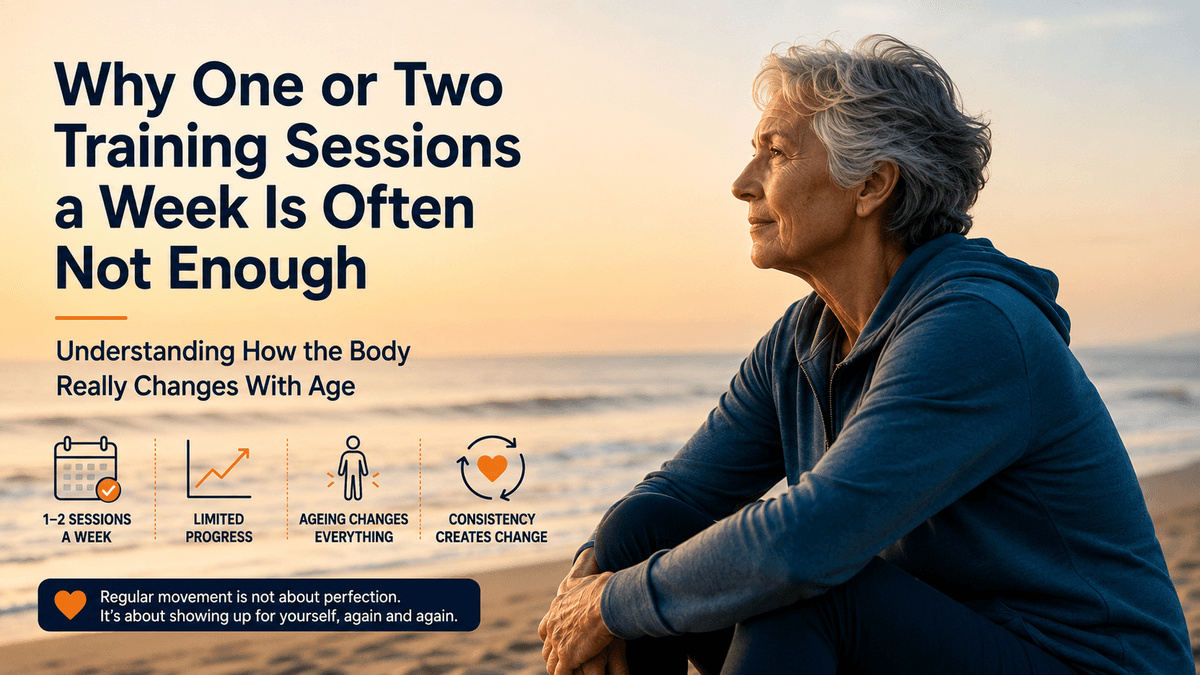
One or two training sessions per week can help maintain contact with movement, improve mood, create routine, and provide social connection.
But when the goal is real physical improvement — better strength, mobility, balance, coordination, confidence, agility, energy, or independence — the reality is often very different.
Especially after the age of 60, 70, or 80.
This article is not written to discourage anyone.
It is written to help people understand how the body truly works, so they can make more intelligent and realistic decisions about their health and movement practice.
Because good decisions are easier to make when people understand the science behind them.
This is no different from nutrition.
A person who eats excessive sugar and fast food without understanding the consequences may not realise how strongly those habits affect body weight, inflammation, energy, cardiovascular health, and long-term wellbeing.
But once people understand the effects, they can make informed choices.
The decision is still theirs.
This article follows the same principle.
The goal is not to judge anyone.
The goal is to inform.
Because expectations should be aligned with biological reality — not with myths, marketing, or wishful thinking.
What International Health Guidelines Actually Recommend
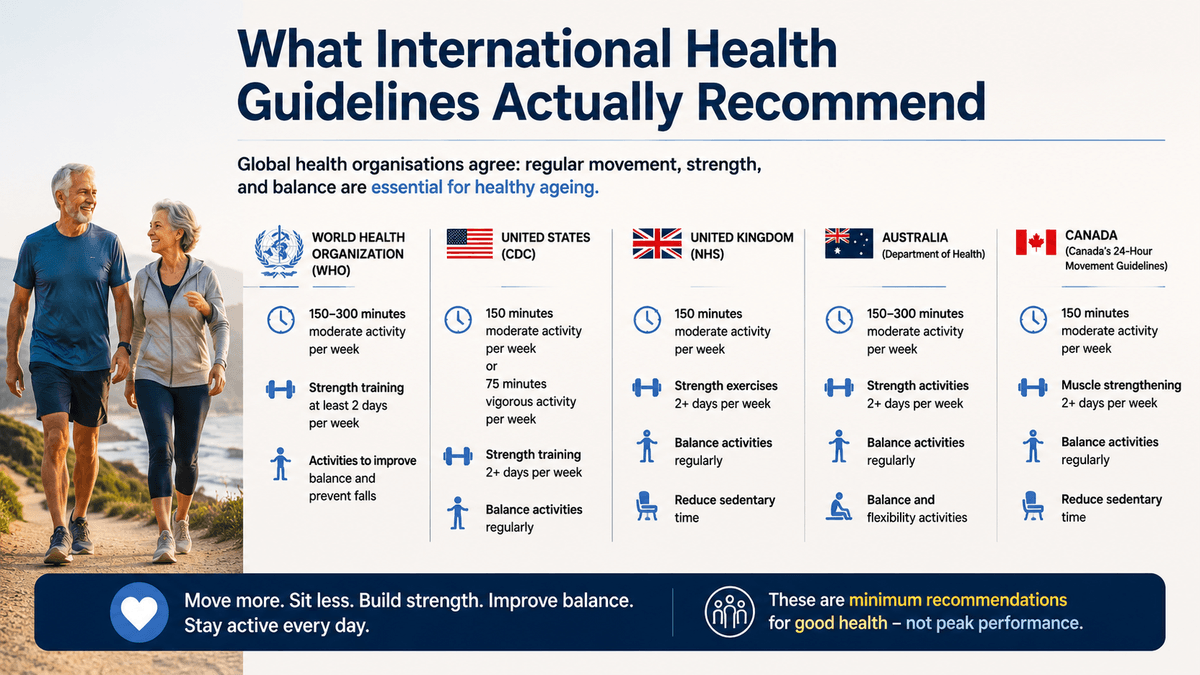
One important point is that the ideas discussed in this article are not only personal opinions or “fitness industry trends.”
They are strongly aligned with the recommendations of major international health organisations and developed countries such as:
- the United States,
- the United Kingdom,
- Australia,
- Canada,
- and the World Health Organization (WHO).
Although wording varies slightly, the message is remarkably consistent.
Most international guidelines recommend that older adults should aim for:
- at least 150–300 minutes per week of moderate physical activity, or
- 75–150 minutes of vigorous activity, when appropriate,
- plus strength training at least two days per week,
- and regular work on:
- balance,
- mobility,
- coordination,
- and functional movement.
Many guidelines also emphasise something extremely important:
Older adults should try to move regularly throughout the week — not concentrate all activity into one isolated session.
The guidelines from countries such as Australia and the UK also specifically highlight:
- reducing sedentary behaviour,
- staying physically active daily,
- maintaining independence,
- preventing falls,
- preserving muscle mass,
- and protecting brain health and cognitive function.
And importantly:
These guidelines are minimum recommendations for general health.
Not optimal recommendations for high performance, rapid improvement, or advanced physical transformation.
Of course, every individual is unique.
A person’s health conditions, pain, injuries, medical history, emotional state, confidence level, mobility restrictions, and life circumstances all matter.
There is no “one-size-fits-all” solution.
But understanding the principles behind these guidelines helps people create more realistic expectations.
The Body Only Improves What It Needs
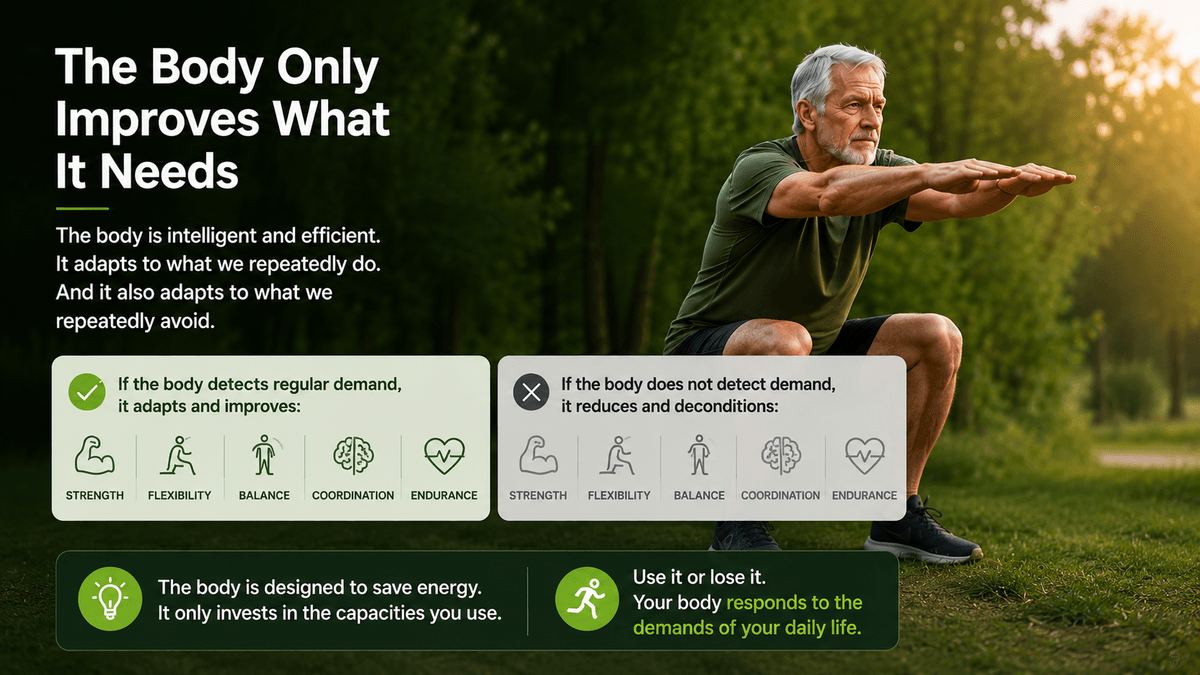
The human body is extremely intelligent.
It does not waste energy developing abilities that are not necessary for daily life.
If the body notices that strength is required regularly, it adapts by becoming stronger.
If the body notices that flexibility is necessary, it slowly works to maintain or improve mobility.
If balance, coordination, agility, reaction speed, and endurance are used consistently, the body understands:
“These abilities are important for survival and daily function.”
And then it invests energy into maintaining and improving them.
But if those capacities are rarely used, the body does the opposite.
It reduces them.
Not because the body is “failing.”
But because the body is efficient.
From a biological perspective, maintaining muscle mass, mobility, coordination, and physical fitness requires energy. If the body does not detect regular demand for those capacities, it gradually stops investing resources into them.
In simple terms:
The body adapts to what we repeatedly do.
And it also adapts to what we repeatedly avoid.
The Principle of Positive Stress
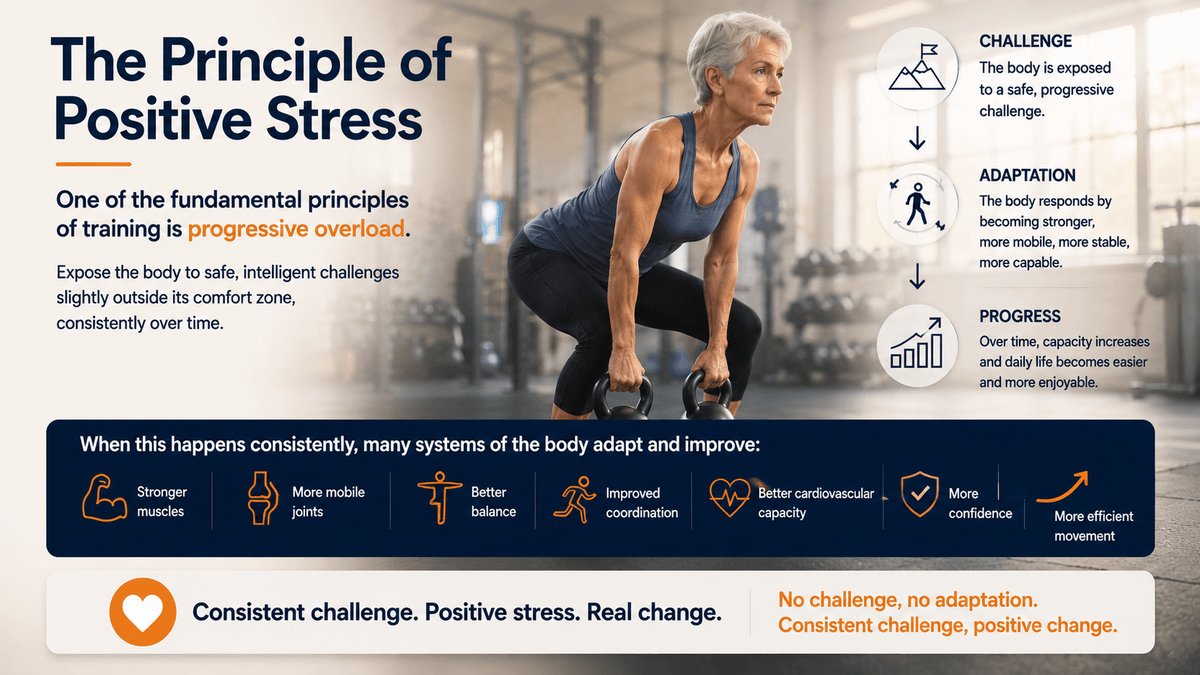
One of the fundamental principles of training is progressive overload.
This does not mean exhausting the body or pushing through pain.
It means exposing the body to safe, intelligent, progressive challenges slightly outside its comfort zone.
When this happens consistently, many systems of the body begin working together to adapt:
- muscles become stronger,
- joints become more mobile,
- balance improves,
- coordination improves,
- cardiovascular capacity improves,
- confidence improves,
- movement becomes more efficient.
The body receives a message:
“I need to become more capable because life is demanding more from me.”
Without regular challenge, the opposite happens.
The body says:
“This capacity is not necessary anymore.”
And slowly, strength, mobility, coordination, and resilience begin to disappear.
Ageing Changes the Speed of Learning
One of the most misunderstood realities of ageing is not only the physical side.
It is the neurological side.
Many mature adults still have the ability to learn new movements and create new neural connections.
That ability does not disappear.
But there is an important difference:
New neural connections usually take longer to establish.
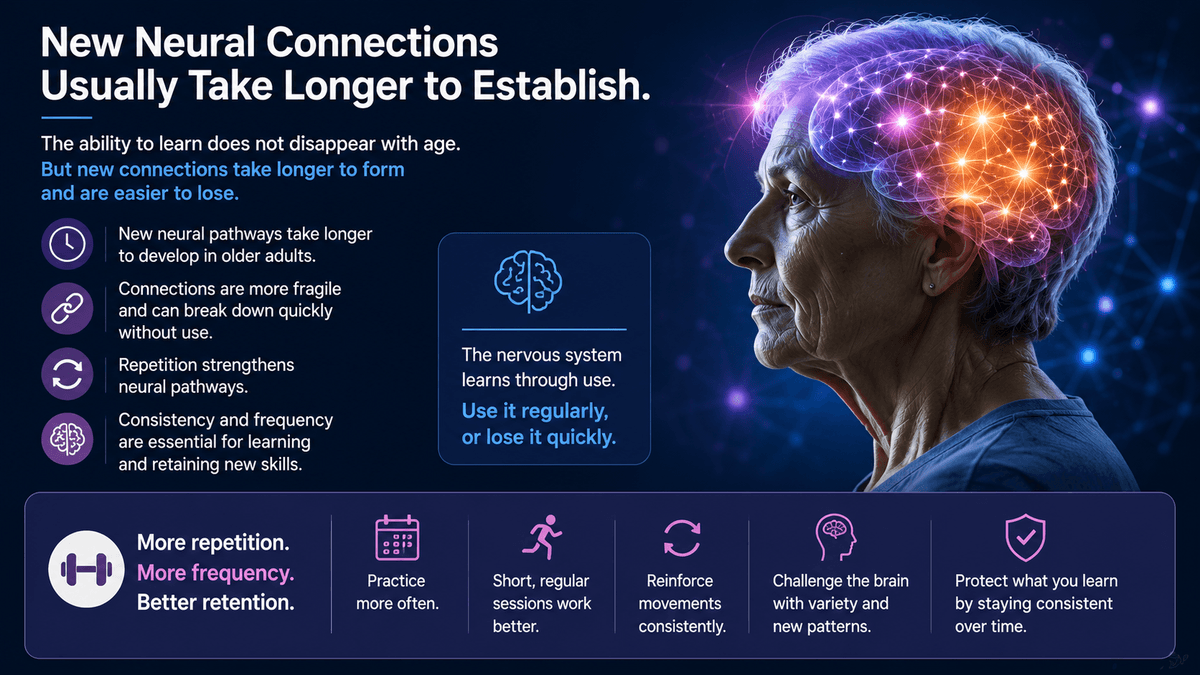
And they are also easier to lose.
This means mature adults often need:
- more repetition,
- more consistency,
- more frequency,
- and more exposure to movement practice.
Movement is not only about muscles.
Movement is also:
- nervous system learning,
- coordination,
- motor memory,
- timing,
- spatial awareness,
- balance,
- reaction,
- and confidence.
The nervous system learns through repetition.
Every repetition helps strengthen neural pathways.
But here lies one of the biggest challenges of ageing.
Many mature adults start learning a new movement and quickly say things like:
“I am stupid.”
“I can’t learn this.”
“I keep forgetting.”
“My memory is terrible.”
“I am too old for this.”
“We are always repeating the same thing.”
But in most cases, this has nothing to do with being stupid, incapable, or “too old.”
It often has much more to do with how the nervous system learns.
And the nervous system needs repetition.
Of course, if memory loss becomes unusually severe, it is important to consider other factors and seek professional advice. Sleep quality, stress, anxiety, depression, medication, fatigue, pain, poor nutrition, dehydration, social isolation, and lack of mental stimulation can all affect memory and concentration.
But in the context of movement learning, what I often see is much simpler:
People are not practising frequently enough for the brain and body to remember.
A good comparison is learning a new language.
Imagine someone wants to learn Portuguese and attends a language class twice per week. But outside those two classes, they never practise. They do not read, listen, speak, repeat vocabulary, or use the language in daily life.
What will happen?
At first, they may learn a little. But very quickly, progress slows down. Between lessons, the brain forgets much of what was introduced. Then, in the next class, the teacher has to repeat the same material again and again.
The person may then start believing:
“I am bad at languages.”
But the real problem may not be lack of ability.
The real problem is lack of repetition.
The same happens with movement.
If a person only practises once or twice per week, and does almost nothing between sessions, the body and nervous system do not receive enough reinforcement to consolidate the learning.
Then the person forgets the sequence, the coordination, the timing, or the technique.
Not because they are failing.
But because the method is incomplete.
This is why repetition is not boring.
Repetition is how the nervous system builds confidence.
Repetition is how the body remembers.
Repetition is how movement becomes natural.
Without enough repetition, many people begin to develop negative beliefs about themselves. They may lose confidence, feel frustrated, compare themselves with others, and start believing that ageing means decline, failure, or incapacity.
But very often, the issue is not ageing itself.
The issue is not understanding how the body learns.
At Empowered Ageing, part of our role is to provide a method.
Not only exercises.
A method.
A way to understand the body, practise with intelligence, repeat safely, build confidence, and slowly transform what once felt impossible into something familiar, natural, and empowering.
Older Bodies Cannot Usually Tolerate the Same Volume of Repetition

A younger body can often repeat movements many times without major problems.
This allows:
- faster learning,
- stronger neural connections,
- and quicker physical adaptation.
But mature bodies are often more fragile.
Joints may be sensitive.
Recovery may be slower.
Muscles fatigue more quickly.
The risk of overload or injury is higher.
This means older adults often cannot safely perform the same number of repetitions as younger individuals.
And this creates a challenge:
- fewer repetitions,
- slower learning,
- slower neural adaptation,
- and faster loss of what was learned if practice is inconsistent.
This is one of the reasons why many mature adults feel that they “forget movements” quickly when they only train once or twice per week.
It is not because they are incapable.
It is because the nervous system requires more regular reinforcement.
Why Some People Progress — And Others Stay Stuck
At Empowered Ageing, we see this constantly.
Some clients improve dramatically:
- better mobility,
- better posture,
- more confidence,
- more strength,
- more fluid movement,
- better balance,
- and even major emotional transformation.
But there is usually one common factor:
consistency.
The people who improve most are often those who stay physically active almost daily.
Not necessarily through intense training.
But through regular movement exposure:
- walking,
- mobility work,
- strength training,
- yoga,
- Animal Flow,
- Vital Flow group class,
- balance exercises,
- paddle,
- swimming,
- home practice,
- or other physical activities.
On the other hand, some people attend one or two sessions per week and expect major transformation while remaining mostly inactive the rest of the time.
Usually, progress becomes very slow after the initial weeks.
Then frustration appears.
People compare themselves with others and start believing:
- “I am weak.”
- “I am too old.”
- “I have too many limitations.”
- “Others are naturally better than me.”
But very often, the difference is not talent.
It is exposure, repetition, frequency, and consistency.
Two Sessions Per Week Can Be Excellent — Depending on the Context
This is important to clarify.
At Empowered Ageing, we also offer people the possibility of attending two sessions per week (private coaching, small groups or group classes).
And for many people, that can be fantastic.
But usually because those people are weekly also active in other ways.
For example:
- two Vital Flow sessions,
- one yoga class,
- regular walking,
- paddle,
- swimming,
- mobility practice at home,
- or other physical activities during the week.
That creates enough total movement exposure for the body and nervous system to keep adapting.
The problem is not “two sessions.”
The problem is when those two sessions are the only meaningful movement the person does all week.
In that case, physical progress is usually limited.
Again:
better than nothing? Absolutely.
Enough for major transformation?
Unfortunatly not.
The Goal Is Not Perfection. The Goal Is Rhythm.
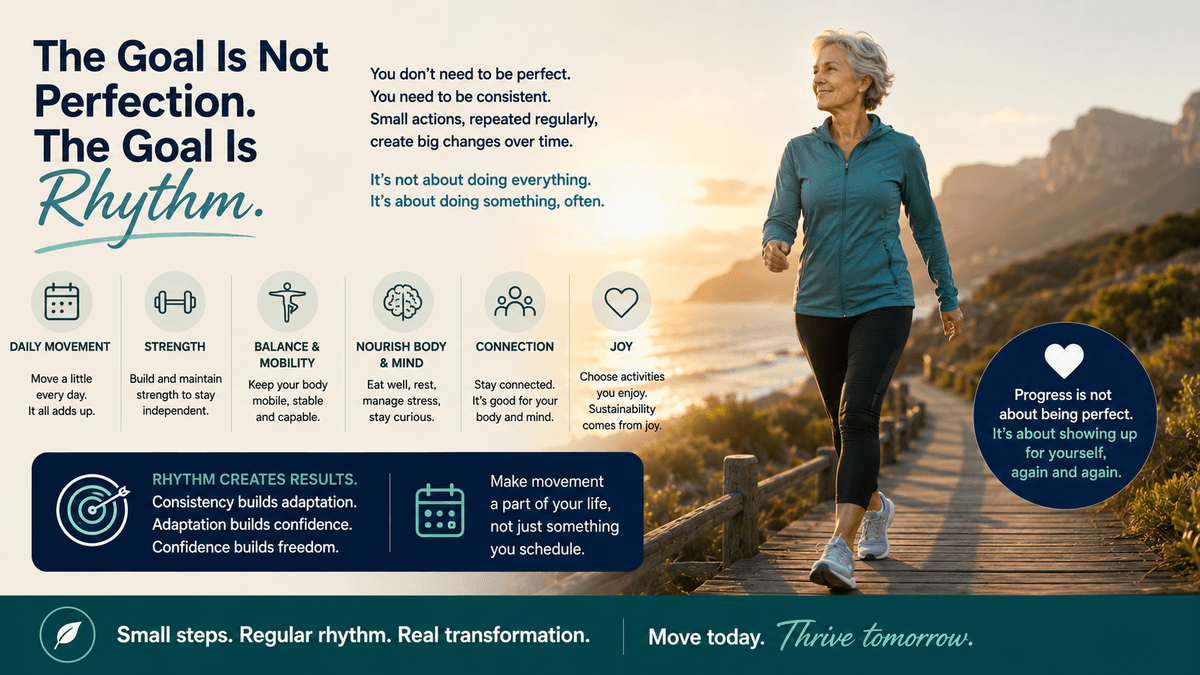
This article is not about guilt.
It is not about becoming obsessed with exercise.
It is about understanding that the body responds to regular signals.
Movement needs to become part of life — not just an isolated appointment in the week.
Even small amounts of daily movement matter:
- mobility,
- walking,
- getting up from the floor,
- balance practice,
- gentle strength work,
- coordination exercises,
- breathing,
- movement snacks during the day.
Consistency creates adaptation.
Adaptation creates confidence.
Confidence creates motivation.
And motivation creates long-term transformation.
Empowered Ageing Is About Understanding the Body
At Empowered Ageing, our mission is not simply to make people exercise.
It is to help people understand:
- how the body works,
- how ageing works,
- how the nervous system learns,
- how confidence is rebuilt,
- and how movement can become enjoyable again.
Because when people understand the process, they stop blaming themselves.
And when fear, shame, frustration, and unrealistic expectations disappear, something powerful happens:
People begin moving with more trust, more consistency, and more joy.
And that is often when real transformation begins.
Knowledge matters.
Scientific understanding matters.
Because better knowledge helps people make better decisions.
And better decisions create better long-term outcomes.
Final Reflection
One or two training sessions per week may help you stay connected to movement.
But lasting physical transformation requires movement to become part of your lifestyle — not just part of your schedule.
Written by Arlindo Martins for Empowered Ageing