

A Reality That Continues to Shock Me
After almost 40 years of teaching physical education, sports and movement, including 12 years coaching mature adults, something still surprises and concerns me deeply.
Many people arrive at Empowered Ageing convinced they are physically active and reasonably fit.
They walk three times a week, swim occasionally, attend yoga classes, travel and manage their daily routines. They genuinely believe this is enough to stay fit and functional for life.
But during our initial movement assessment, which takes approximately two sessions, they often discover something unexpected.
They cannot perform movements they genuinely believed they could still do.
I ask them to perform some basic human movements:
- Sit on the floor and stand up again, including from a lying position.
- Lie on their stomach and push their upper body away from the floor using their arms.
- Step onto a platform just 20 centimetres high without assistance.
- Perform a deep squat, ideally bringing their bottom towards their heels, as young children naturally do.
- Perform a lunge, stepping forward, lowering the back knee towards the floor and returning to standing.
- Move from a crawling position on hands and knees into a seated position on the floor.
Many struggle with these movements. Some cannot perform them at all because of limitations in strength, mobility, balance or coordination.
Recently, I invited a client to hold an overhead bar and gradually transfer some of her body weight onto her arms, with the possibility of lifting her feet off the ground.
She confidently said, "Yes, I'll try!"
But before she could even lift her feet, with only a small proportion of her body weight supported through her arms, she experienced pain in one shoulder.
She had no idea this would happen.
Other clients cannot push themselves up from a face-down position on the floor. They need to roll onto their side and find another way to stand.
And I'm talking about people in their 60s and 70s, not people aged 100 or 110.
Remember, we are not asking anyone to perform handstands, backflips or advanced gymnastics.
We are talking about basic human movement abilities.
What shocks me most is not simply that people struggle.
It is that they often have no idea how much physical capacity they have lost.
A Moment With My Father I Will Never Forget

I remember something that happened with my father when he was around 85 or 86 years old.
During his later years, he had become very sedentary, spending most of his days sitting and watching television.
One day, he asked me to help him move an object in the garage.
We stood on opposite sides. I grabbed my side and lifted, expecting him to lift his.
But nothing happened.
He looked at me for about five seconds, with an expression of surprise and fear.
Then he said:
"Oh, I cannot lift this!"
He genuinely had not realised how much strength he had lost.
That moment stayed with me.
My father had not suddenly become weak that day. His strength had probably been declining gradually for years.
But because his daily life no longer required him to lift or carry demanding objects, he had never noticed.
Until that moment in the garage.
Physical decline can be dangerously silent. We may lose abilities so gradually that we only discover the loss when life suddenly demands them.
Have We Made Our Lives Too Comfortable?

Look around you.
Cars replace walking. Lifts and escalators replace stairs. Moving walkways carry us through airports. Electric bicycles can reduce much of the physical effort of cycling.
Shopping trolleys carry our groceries. Robot vacuum cleaners clean our floors. We order almost everything online.
We sit on comfortable sofas, raised beds, dining chairs and car seats.
Many of us rarely need to squat deeply, kneel, crawl, climb, carry heavy objects, push, pull or get down onto the floor.
Technology has brought extraordinary benefits, but it has also removed countless opportunities to challenge our bodies.
And here is the paradox.
We have made our lives so physically comfortable that we can spend years without discovering what our bodies can no longer do.
Some people might ask:
"Arlindo, why do we need all these movements anymore? We live in a technologically advanced society. Life no longer requires so much physical effort!"
My answer is simple.
Until something unexpected happens.
Until you trip, fall, need to get up from the ground, lift something heavy or react quickly to avoid an accident.
Suddenly, abilities that seemed unnecessary become extremely important.
For a deeper reflection, read The Body Was Made to Move. Modern Life Stopped Asking.
"But I Walk Three Times a Week!"
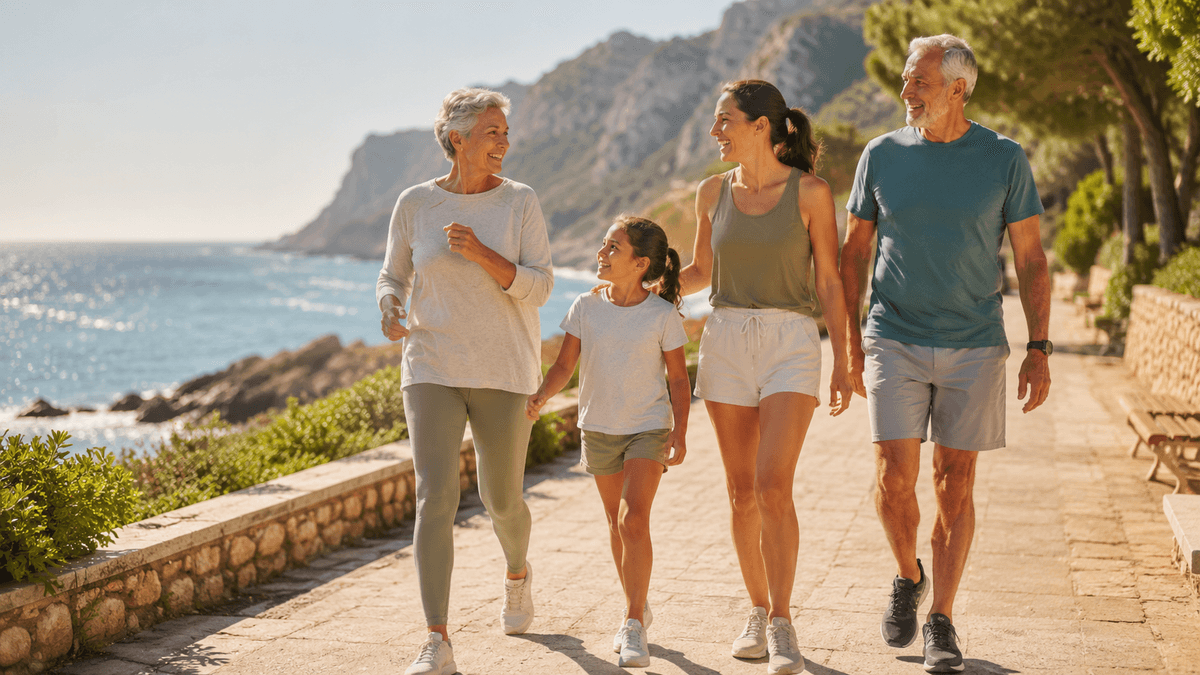
I hear this almost every week.
Walking is valuable, and I strongly encourage it.
But walking alone is not a complete physical training programme.
If you trip, can you react quickly enough to take two or three rapid steps to recover your balance?
If you fall forward, do your arms and shoulders have enough strength and control to help protect you?
Can you lower yourself to the floor and stand up again?
Can you perform a controlled lunge or squat?
Walking at a comfortable pace on level ground does not adequately develop all these abilities.
Yet walking is frequently recommended, including by health professionals, without always explaining the importance of developing other physical qualities.
Walking five kilometres does not automatically mean you have the strength, balance, agility and reactions needed to deal with unexpected physical challenges.
That is why, at Empowered Ageing, we don't rely on just one exercise programme or training system.
We combine different movement approaches because each offers specific benefits.
Strength training, balance challenges, mobility exercises, functional movements, coordination, agility, reaction training and different movement disciplines all contribute to developing a more capable body.
This variety also makes training more stimulating, enjoyable and motivating.
We are not training people simply to become better at one exercise.
We are helping them become more capable of dealing with life.
To understand why variety matters, read Should My Weekly Exercise Programme Include Many Different Activities?.
"I'm Too Old!" — Are You Sure?

This is another expression I hear regularly.
A client struggles with a movement and immediately says:
"Well, I'm getting old!"
Sometimes the person is only 70 or 75.
And I often challenge that explanation.
Are you unable to perform the movement simply because you are 73?
Or because you have spent years without practising it?
Think about the deep squat.
In some cultures, squatting close to the ground remains part of everyday life, including among older adults.
In many Western lifestyles, however, we spend decades sitting on chairs and rarely exploring deeper knee and hip positions.
Over time, these movements become unfamiliar, uncomfortable or physically difficult.
Of course, ageing brings biological changes, and injuries or medical conditions can also affect our abilities.
But we must stop automatically blaming age for every physical limitation.
There are people in their 80s and 90s who remain remarkably strong, mobile and agile.
Their abilities reflect not just their age, but also their health, movement history and lifestyle.
Instead of immediately saying, "I'm too old," perhaps we should ask:
"Have I stopped using this ability?"
That question can change everything.
Unfortunately, Many People Only Wake Up After They Start Falling

This is one of the most difficult realities of my work.
Many people only contact Empowered Ageing after they have started falling.
Not just once.
Sometimes they fall again and again.
Some have already suffered serious injuries: broken wrists, arms, noses or facial bones.
And suddenly, fear enters their lives.
They become afraid of walking on uneven ground, climbing stairs, leaving home alone or even performing simple exercises.
Some decide that the safest solution is to stop going out and spend more time sitting at home.
But this can create a dangerous cycle.
Fear leads to less movement. Less movement leads to further weakness and reduced balance. And that can increase the risk of future falls.
Of course, falls have multiple possible causes, including medical conditions, medication effects, vision problems and environmental hazards.
But declining strength, balance, coordination and reaction abilities can be important contributing factors.
The fall is often not the beginning of the problem.
It is the moment when years of declining physical capacity become impossible to ignore.
And once fear develops, recovery becomes more challenging.
The person needs movement to rebuild strength and confidence, but may be too frightened to practise independently at home.
This makes creating consistent daily movement routines much harder.
I can help, and meaningful improvement is often possible.
But the process may require much more time, support and careful progression.
It is rarely too late to improve. But sometimes it is too late to recover everything we have lost.
Sometimes a Fall Becomes a Turning Point
There is, however, another side to this story.
I have worked with clients whose falls became a powerful wake-up call.
They realised that something needed to change.
They decided to invest in their physical health, began training consistently and gradually rebuilt strength, balance, confidence and independence.
Some who previously experienced repeated falls have gone long periods without another fall.
But what makes me happiest is not simply that they fall less.
It is seeing how their lives begin to change.
They have more energy. They move with greater confidence. They rediscover the pleasure of being active.
They feel more capable of travelling, walking outdoors, playing with their grandchildren, getting down to the floor, enjoying hobbies and participating in social activities.
Some discover movement abilities they never imagined they could develop at their age.
And with these improvements often comes something even more valuable: a renewed sense of freedom, motivation and purpose.
They don't just become physically stronger. Their world becomes bigger again.
A fall can become a turning point.
But why should we wait for something painful or frightening to motivate us to take care of our bodies?
Why Do We Wait Until Something Goes Wrong?
This question continues to trouble me.
We have access to more health information than ever before.
At Empowered Ageing, we organise educational initiatives such as the Healthy Ageing Seminar to help people understand how their daily choices influence their health, physical abilities and independence.
Yet encouraging people to take an interest before serious problems appear remains surprisingly difficult.
Perhaps we believe we are already active enough.
Perhaps we confuse being busy with being physically capable.
Perhaps we have negative experiences associated with physical education or exercise.
Perhaps we lack motivation, or have mistaken beliefs about how much physical activity our bodies actually need.
Or perhaps we simply assume that losing physical abilities is an unavoidable part of growing older.
Whatever the reasons, one thing remains true:
Not knowing what we have lost does not mean we haven't lost it.
Don't Wait for a Fall to Discover Your Limitations
At Empowered Ageing, our movement assessments are not designed to judge or embarrass anyone.
They are designed to create awareness, identify limitations and discover possibilities.
Not everyone needs to perform a deep squat, hang from a bar or move in exactly the same way. Appropriate challenges depend on each person's health, history and individual needs.
But everyone deserves to understand what their body can do today and what it may be capable of improving.
Don't wait until you fall to discover that you cannot get up.
Don't wait until you trip to discover that your balance reactions are too slow.
Don't wait until fear begins to control your life to realise how much independence you have lost.
The best time to protect your physical abilities is before you start losing them.
At Empowered Ageing, we don't train just for exercise.
We train for life.
Arlindo Martins
Founder & Movement Coach — Empowered Ageing